

Bounded Contexts in DDD (Simple Explanation + Real Examples) 8/10

A Deep Analysis of Essential DDD Concepts to Create Clear and Robust Architectures
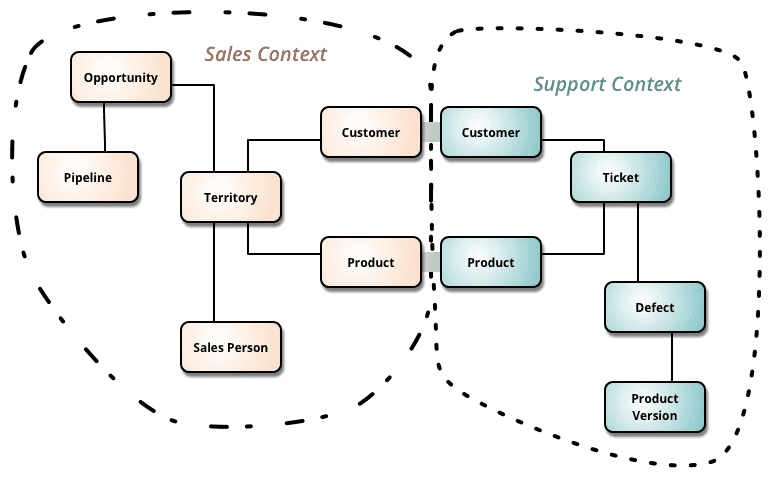
Source: Bounded Context - Martin Fowler
Why is the Bounded Context important in DDD?
InstaKran: Finding candidates for Bounded Contexts
Let's return to the story of InstaKran, the influencer marketing platform from our previous article. The platform connects brands with creators, tracks campaign performance, and manages financial payments. At first glance, this seems like a single huge domain — but this is where the need for Bounded Contexts becomes evident.
Some possible Bounded Contexts for InstaKran include:
- Campaign Management: Defining campaigns, matching influencers, and tracking engagement.
- Creator Onboarding: Managing creator profiles, verifying accounts, and ensuring platform compliance.
- Payment Processing: Handling revenue splits, payments, and financial records.
- Analytics & Reporting: Aggregating data and presenting performance metrics.
Each has distinct business rules, vocabulary, and workflows, making them strong candidates to be separate Bounded Contexts. Without clear boundaries, InstaKran risks tangled logic and inconsistent definitions (for example, what "engagement" means in Reporting vs. Campaign Setup).
Defining clear boundaries for business domains
Bounded Contexts ensure that terms and rules have a consistent and unambiguous meaning within each specific domain area. For example, “Revenue” in the context of Payment Processing may include platform fees and taxes, while Campaign Management only cares about the gross campaign spend. Bounded Contexts prevent these definitions from conflicting.
Managing complexity
Large domains become unmanageable quickly if everything is treated as a single system. Bounded Contexts divide the domain into smaller, focused parts, making the system easier to build, maintain, and evolve. Each context can adapt to its own needs without affecting unrelated areas.
What is a Bounded Context in DDD?
Definition of Bounded Context
A Bounded Context defines the conceptual boundary where a specific domain model applies. Within that boundary, models, rules, and terms remain consistent and meaningful, reflecting the needs of that part of the business. Outside the boundary, other contexts may have their own interpretations.
Key elements of a Bounded Context
- Ubiquitous Language: Each context has a shared and agreed vocabulary that aligns with the terminology of domain experts. For example, “Creator” in Onboarding may imply profile setup and compliance verification, while in Payment Processing only the creator ID and payment details are tracked.
- Domain Model: Tailored to reflect business rules and workflows within the boundary, avoiding unnecessary complexities from unrelated concerns.
- Context Map: Defines how this context integrates with others, showing dependencies, data flow, and communication patterns.
Key responsibilities of a Bounded Context in DDD
1. Ensure model consistency
A Bounded Context ensures that the domain model remains cohesive and consistent. For example, InstaKran's Payment Processing context may define a "Payment" with a payment schedule and tax breakdown — this definition should not be altered by Campaign Management or Analytics.
2. Protect the domain model
External contexts should never directly modify another context's domain model. Communication must occur through well-defined interfaces or events. For example, Campaign Management can request payment data from Payment Processing, but not directly modify financial records.
3. Facilitate communication between contexts
Bounded Contexts define clear integration points, such as APIs or domain events, to collaborate safely without mixing boundaries. For example, Analytics might consume an event like CampaignCompleted to generate reports, instead of directly accessing campaign data.
4. Isolate changes
Contexts evolve independently. Changes in Onboarding (e.g., adding a new creator verification step) should not affect Payments or Analytics. Each team can release updates without waiting on unrelated teams.
Best practices for implementing Bounded Contexts
1. Identify natural business boundaries
Align Bounded Contexts with real business functions and team responsibilities. If different teams handle Payments and Campaigns, they probably need separate contexts.
2. Define a Ubiquitous Language per context
Ensure each context has its own domain vocabulary. In InstaKran, Campaign Management might define an “Influencer” as a content creator with specific audience metrics, while Payment Processing calls them “Payee” with financial details.
3. Use Context Maps to visualize interactions
Context Maps help document relationships:
- Customer-Supplier: One context depends on the output of another (e.g., Analytics depends on Campaigns).
- Anti-Corruption Layer (ACL): Translates between contexts to avoid model contamination.
- Shared Kernel: A small shared model between closely connected contexts (e.g., a common user profile model).
4. Ensure loose coupling between contexts
Use APIs, domain events, or ACLs to avoid direct dependencies on other contexts' models or logic.
5. Maintain autonomy
Teams owning a context should control its model, rules, and releases, minimizing coordination between teams.
Challenges and anti-patterns of Bounded Contexts
1. Blurry context boundaries
Unclear boundaries lead to inconsistent models and accidental coupling. Define contexts deliberately, not as an afterthought.
2. Overlapping ubiquitous language
Using the same term with different meanings across contexts (e.g., “Engagement” in Campaigns vs. Analytics) causes confusion and errors.
3. God Context (Big Ball of Mud)
A single huge context trying to do everything ends with low cohesion and difficult maintenance. Divide according to business capability.
4. Strong coupling between contexts
Directly accessing another context's models or logic breaks separation and invites unwanted consequences. Use integration points.
5. Over-fragmentation
Too many small contexts generate complexity and excessive integration. Balance is key.
Conclusion
Bounded Contexts are essential to manage complexity and ensure clear, maintainable models in Domain-Driven Design. By carefully defining boundaries, creating a shared language, and wisely using integration points, you can build scalable and flexible systems — without falling into anti-pattern traps.
Where do you see possible Bounded Contexts in your own systems? Would you handle them differently now?
These are the next topics we will discuss in this series From Good to Great in DDD. I hope we navigate together through this important architecture:
- From Good to Excellent in DDD: Elevate Code Quality with Domain-Driven Design - 1 / 10
- Entities vs Value Objects in DDD (Clear Explanation with Examples) 2/10
- Aggregates and Aggregate Roots in DDD (Simple Guide with Examples) 3/10
- Repository Pattern in DDD (How It Works with Real Examples) 4/10
- Domain Services in DDD: When and How to Use Them 5/10
- From Good to Excellent in DDD: Understanding Application-Service Patterns in Domain-Driven Design - 6/10
- DDD Architecture Explained Simply (Practical Guide with Examples) 7/10
- Bounded Contexts in DDD (Simple Explanation + Real Examples) 8/10
- From Good to Excellent in DDD: Event-Storming as the Modeling Strategy to Create Domain-Driven Design - 9/10
- From Good to Excellent in DDD: Common Mistakes and Anti-Patterns in Domain-Driven Design - 10/10
Ready to implement Bounded Contexts in your projects with Domain-Driven Design?
At Kranio, we have software architecture experts who will help you define and implement Bounded Contexts effectively, ensuring a solid and scalable structure. Contact us and discover how we can improve your systems' architecture.
Previous Posts
How to implement a database proxy with PgBouncer: step-by-step guide
Learn how to implement a database proxy with PgBouncer. Improve performance, reduce connections, and scale PostgreSQL easily.
Agent Harness: Design Patterns for AI Agents
Discover what an Agent Harness is and the design patterns that transform AI models into agents capable of executing tasks, verifying outcomes, and scaling business processes.