Webinar • 14 de mayo de 2020
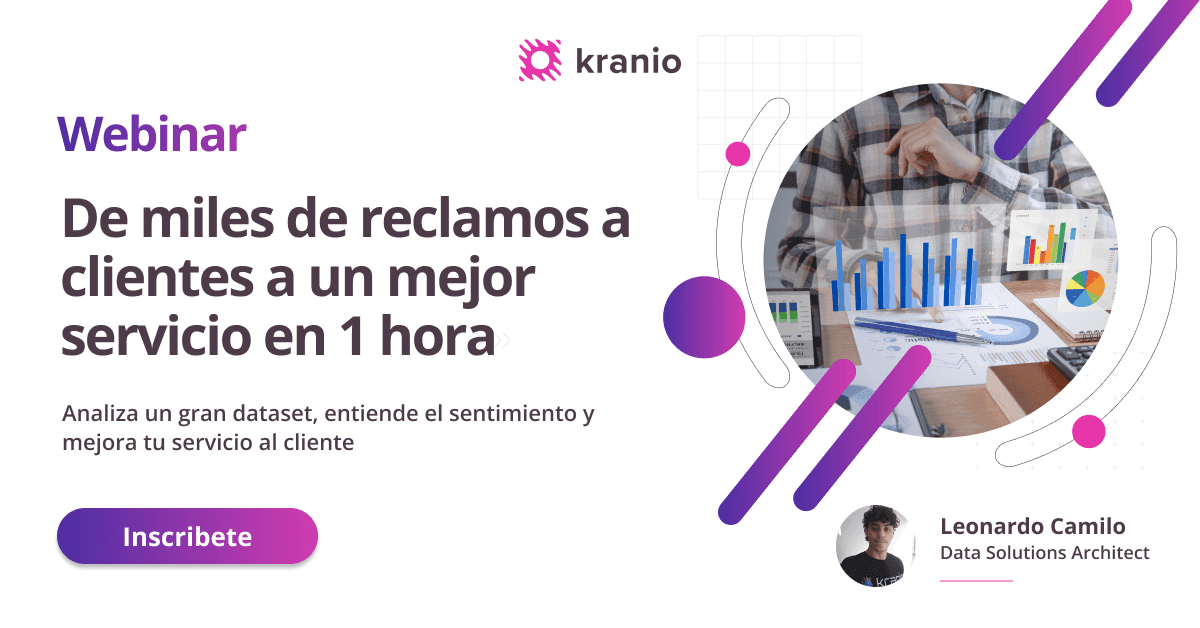
From thousands of complaints to better customer service
Analyze a large dataset, understand sentiment and improve your customer service
Why this webinar
Do you work with clients or products? Having feedback is essential to create a differentiating experience for your offer in the market. PM's, Sales Leaders, etc.
In just 1 hour you will learn to analyze a lot of data, transform, calculate and rate it according to the feeling it provokes: negative, neutral or positive. You will be able to understand the conversations that customers have about your business.
From emails they send you, forms they fill out or on social networks, you will evaluate the "conversations": which are positive and which are negative.
Then, you can take actions to improve the service and increase sales.
Aimed at:
- Customer Areas, Marketing, Business, Commercial, Financial, Projects, BI, Digital Transformation
- Product Managers, Business Developers, Programmers, Architects or Data Specialists
If you are not a computer specialist, don't be scared! You will be able to do a simple analysis using the Templates.
After the Webinar, you will receive the Template Kit in your email and you will be able to create your data products.
Details
Step 0: Introduction and Objective of the session
- What will you learn, what is the case that we are going to solve, how and why can it be useful to you, and how fast?
- Will this be useful for other types of data? For my data?
- From 0 to 'Something'.
Step 1: Choosing the data set
- What are the characteristics, why we chose it, that we are going to analyze.
- What metrics do we want to extract? We will provide you with templates so you can choose a set of data (whether emails, service tickets, messages from a bot or forms that users filled out).
Step 2: Enable Necessary Infra
- From the data, to software or apps to work with.
- Good practices to quickly enable infra (CI/CD).
- Template Kit code so you can make your setup in a few minutes.
- How to save time to focus on the analysis.
Step 3: From the data to the First Analysis
- Why use Jupyter and Python to transform the data?”
- If you are not a programmer, don't worry.
- You will be able to do everything you have learned with the help of the templates
Step 4: First indicators, calculations, transformations
- We will start with the concept of Exploratory Analysis.
- Models and data representation.
- We will create an analysis model of words and phrases to classify them as negative, neutral or positive.
Step 5: Visualization of the Analysis
- We will create a dashboard with AWS QuickSight.
- What is the customer sentiment?
- Positive, neutral or negative?
- What are the main customer conversations that we should attend to?
- To make decisions and improve the service.