

Fine-tuning for fraud detection: when it makes sense

Imagine a fintech that has just launched peer-to-peer payments. In its first eight months of operation, it accumulated 2,400 confirmed fraud cases… enough to be concerning, but not enough to train a robust model from scratch. The data team has two paths: build a new classifier with those 2,400 cases, or take a model already trained on payment fraud from another industry and adapt it with fine-tuning to its own transaction pattern. The decision between the two paths is not a technical preference: it is a cost-and-time decision that recent evidence makes it possible to make with data, not intuition.
This article is not about fine-tuning chatbots or conversational models. It is about fine-tuning applied to classic classifiers, transactional time-series models, and vision models for documents—the kind of AI already operating inside most risk and compliance systems.
1. When is fine-tuning worthwhile for fraud detection?
The advantage of transferring weights depends on the size of the proprietary dataset. The Tab2Visual study (ArXiv, 2025\) showed that on small datasets, pretraining delivers average gains of 7.5% to 11% in AUC, whereas on massive datasets (\>100K records), the improvement drops to just \~1%.
With 2,400 cases, the fintech in the example falls within the highest-return zone for fine-tuning. By contrast, a traditional bank with hundreds of thousands of fraud cases would hardly justify the computational complexity of transferring weights.
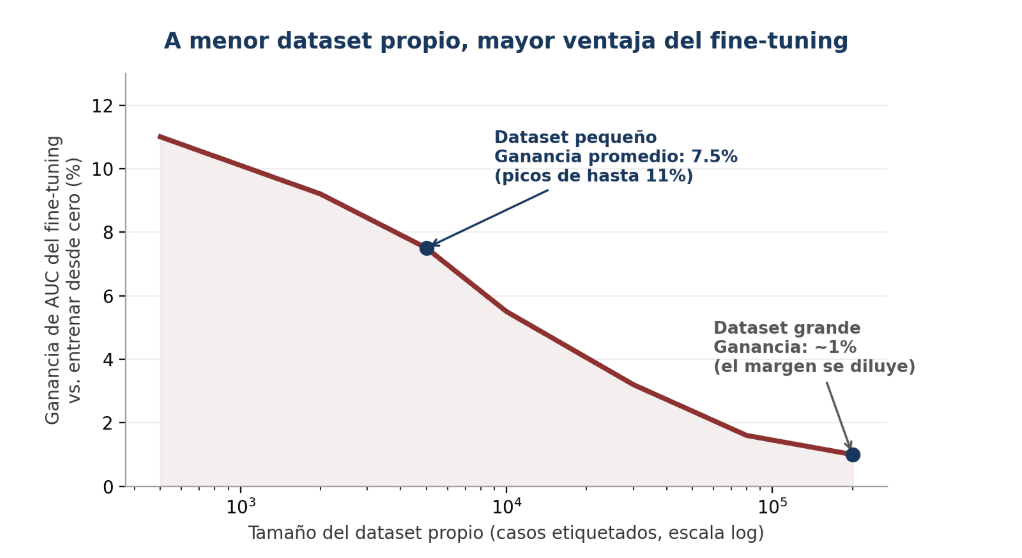
Figure 1\. Tab2Visual curve (ArXiv, 2025): the smaller the proprietary dataset, the greater the advantage of fine-tuning (gain of 7.5% to 11% in AUC), compared with large datasets (\~1%).
Why not simply XGBoost or LightGBM?
On flat tabular data, boosting algorithms such as XGBoost or LightGBM remain the standard because of their speed and interpretability. Fine-tuning provides an advantage when the proprietary data is too scarce to generalize without overfitting, or when multimodal signals are integrated: web browsing, graphs of relationships between accounts, and device biometrics.
Operational risks: why the model requires MLOps
The benefit of fine-tuning is neither automatic nor permanent. Research on transfer learning in anomaly detection (ArXiv, 2024\) confirms that tuning complex networks on small samples carries two critical vulnerabilities:
- Overfitting: the model memorizes peculiarities of historical fraud without developing the ability to generalize to emerging attacks.
- Concept drift: fraud patterns mutate quickly; a static model decays within months if criminal groups change tactics (ScienceDirect, 2023).
Without continuous retraining, transferring weights moves direct financial risk into the business. Therefore, fine-tuning must be conceived as a living MLOps cycle equipped with constant observability and data governance.
2. A practical path for deciding: applied case and technical validation
Determining the viability of fine-tuning is not defined by intuition, but by isolating critical variables and comparing the base model against a baseline in a controlled temporal benchmark.
Transfer requires coherence in the feature space: a card fraud model transfers effectively to bank transfers (amounts, frequency, geolocation), but fails for identity authentication, where the signals come from pixels and biometrics.
Critical variables in a real case (P2P fintech, 2,400 fraud cases):
Velocity: outgoing transfers within 5/15-minute windows and the ratio of amount vs. average balance.
Telemetry: variations in device fingerprint and geographic jumps by IP in less than 1 hour.
Topology: transfers to newly created destination accounts (bridge accounts or mules).
The technical experiment: baseline vs. layer adaptation
On a time-based split to avoid data leakage, a tabular model trained from scratch (XGBoost) is compared with a neural network pretrained on payment patterns.
In practice, adapting the base model does not train the entire network; instead, it freezes the universal representations (backbone) and tunes only the classification head with a low learning rate (10⁻⁴):
import torch.nn as nn

def prepare_finetuning_model(pretrained_model, num_local_features):
    # 1. Freeze base weights to preserve representations and prevent overfitting
    for param in pretrained_model.backbone.parameters():
        param.requires_grad = False

    # 2. Replace the output layer to calibrate it to the 2,400 proprietary fraud cases
    embedding_dim = pretrained_model.backbone.output_dim
    pretrained_model.classifier = nn.Sequential(
        nn.Linear(embedding_dim, 32),
        nn.ReLU(),
        nn.Dropout(0.3),
        nn.Linear(32, 1)  # Sigmoid output for fraud probability (0 to 1)
    )
    return pretrained_model
Decision matrix and impact metrics
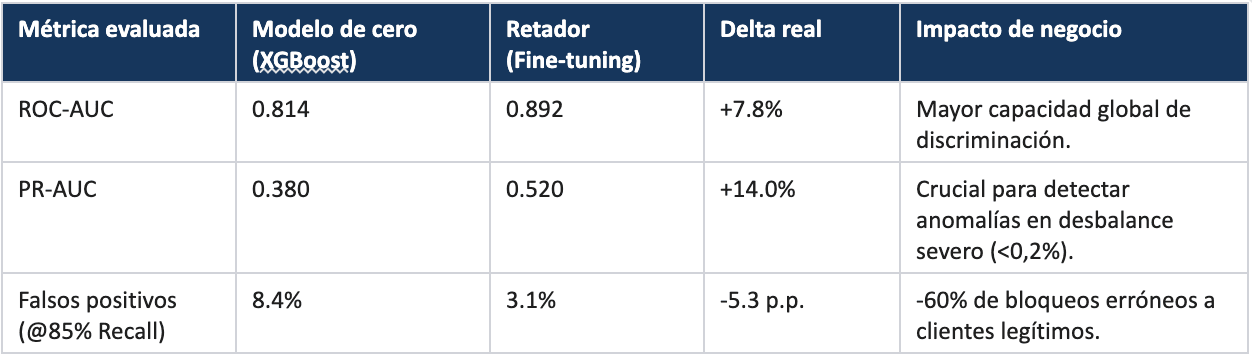
Decision Gates:
NO-GO (Delta PR-AUC \< \+3%): discard fine-tuning. The margin does not justify maintaining neural networks; it is better to keep XGBoost and optimize manual features.
GO (Delta PR-AUC \> \+5% and drop in alerts): green light for production. It is mathematically demonstrated that transferring weights contributed generalization that proprietary data could not achieve alone, justifying the deployment of the architecture on AWS.
3. MLOps architecture on AWS and FinOps optimization
Deploying fine-tuning in regulated production environments requires governance, elasticity, and traceability. At Kranio.io we design cloud MLOps architectures that orchestrate this cycle end-to-end on AWS SageMaker:
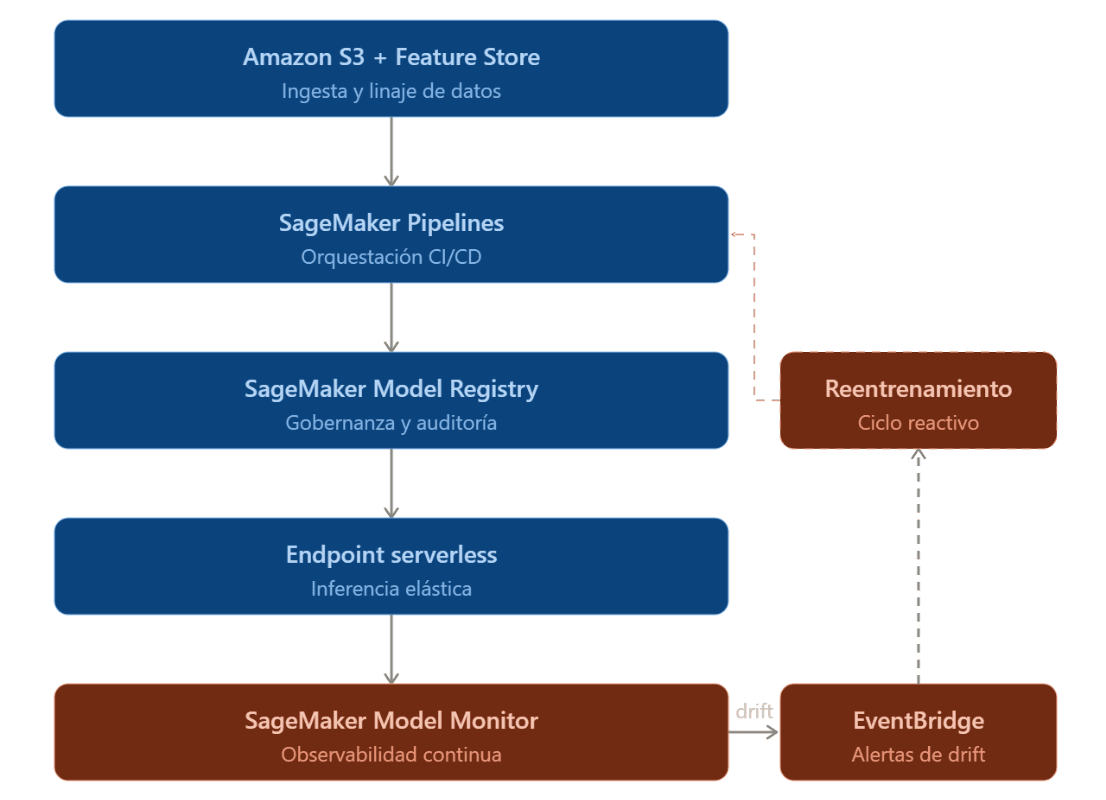
Figure 2\. Reference MLOps architecture on AWS SageMaker for continuous fine-tuning in transactional risk: governed ingestion, CI/CD pipeline, elastic serverless inference, and reactive cycle for concept drift.
Five components sustain this production cycle:
- Ingestion and lineage: Amazon S3 and SageMaker Feature Store version features, preventing training-serving skew.
- Orchestration: SageMaker Pipelines automates preparation, tuning, and evaluation in versioned and reproducible workflows.
- Governance: SageMaker Model Registry audits lineage and requires human approval before promoting to production.
- Inference: Serverless Endpoints with Provisioned Concurrency absorb spikes with low latency and no idle costs.
- Active observability: SageMaker Model Monitor detects drift and triggers retraining via Amazon EventBridge.
FinOps: the real cost of inference versus training
In transactional risk, the critical cost is not training but availability: retraining for 20 hours on GPU (ml.p3.2xlarge) costs \~US$76 one-time; maintaining a dedicated endpoint 24/7 requires \~US$165.60/month fixed.
On Serverless (2 GB, 100 ms), evaluating 10 million monthly transactions costs \~US$40.16 (\~US$0.000004 per evaluation). The breakeven versus dedicated instances occurs only at \~41 million transactions per month. Through FinOps optimization practices, institutions can audit actual compute consumption and size infrastructure according to business seasonality.
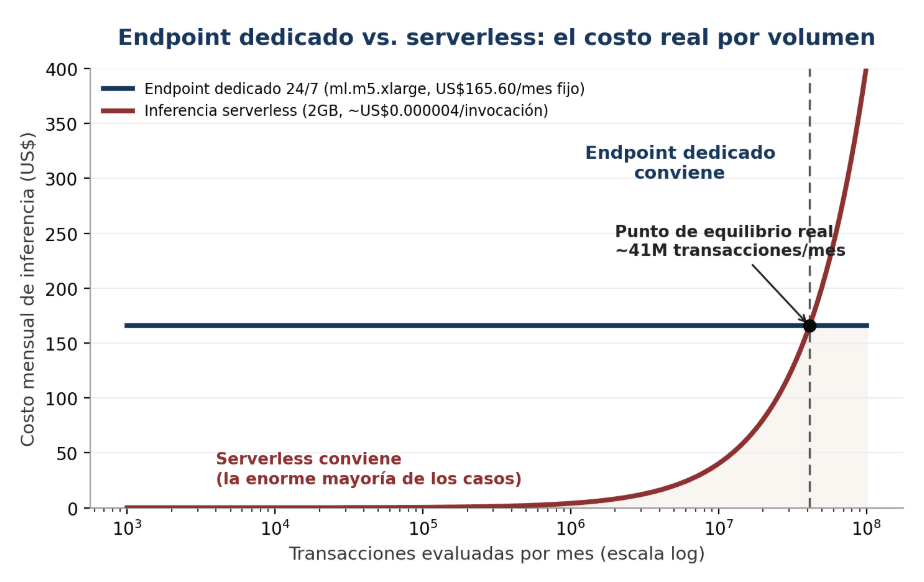
Figure 3\. FinOps curve on AWS SageMaker: dedicated vs. serverless inference cost. The breakeven point occurs at \~41 million transactions per month.
Mitigating cold start: Dual-Tier Scoring architecture
To overcome cold start in Serverless without absorbing dedicated fixed costs, the recommended pattern is Dual-Tier Scoring:
- Tier 1 — Online validation (\<50 ms): a lightweight classifier or rules evaluate the transaction in the critical flow, approving or blocking obvious cases.
- Tier 2 — Asynchronous deep scoring: doubtful transactions pass through event queues to the fine-tuned model, evaluating complex patterns without delaying the response.
4. Application in companies: real impact in banking, fintech, and e-commerce
Understanding algorithmic feasibility and cloud architecture allows you to gauge how these solutions operate in the real world. The effectiveness of fine-tuning and MLOps has large-scale production implementations audited by the global financial industry, delivering measurable benefits in operational efficiency, cost savings, and scalability:
HSBC and Google Cloud: Dynamic Risk Assessment (DRA) at global scale
The challenge: traditional anti-money laundering (AML) and banking fraud systems relied on fixed rules engines. This scheme generated millions of monthly alerts with a false positive rate above 95%, forcing hundreds of analysts to spend several weeks investigating legitimate transactions.
The technology solution: in partnership with Google Cloud, HSBC implemented Dynamic Risk Assessment (DRA), adapting the AML AI base through fine-tuning on the bank's own historical and compliance records. Instead of evaluating isolated rules, the neural network analyzes graphs of relationships between accounts, temporal sequences of transfers, and subtle anomalies in customer behavior.
Measured impact in production:
- Active monitoring of more than 1 billion monthly transactions in markets such as the United Kingdom, Mexico, and Singapore.
- Detection of 2x to 4x more actual suspicious activity compared with the previous fixed-rules scheme.
- Reduction of more than 60% in the volume of false-positive alerts, eliminating the operational bottleneck.
- Compression of case investigation times from weeks to just a few days, a milestone recognized by the Celent Model Bank Award (2023) and HSBC reports (2025/2026).
American Express: solving the 'cold start' in new segments
The challenge: when enabling new cross-border payment corridors or niche merchant categories, the scarcity of historical fraudulent transactions (often fewer than a thousand labeled cases) made it impossible to train robust supervised classifiers without memorizing noise.
The technology solution: AmEx adopted transfer learning and fine-tuning by reusing deep neural representations trained on its enormous consolidated global volumes. The architecture freezes the base layers that model universal consumption habits and retrains only the upper dense layers with data specific to the new segment.
Measured impact in production: the institution achieved an increase of up to 6% in predictive accuracy in specific segments, safeguarding new business lines from day one without waiting years to accumulate labeled history (Articsledge, 2026).
E-commerce platforms: multimodal detection with CFD-BERT
The challenge: in digital commerce and payment gateways, modern frauds (such as empty product returns, account takeover, or coordinated transactions) bypass numeric tables because amounts and times appear legitimate; the criminal signal is hidden in unstructured text and behavioral signals.
The technology solution: initiatives such as CFD-BERT (Consumer Fraud Detection BERT) apply supervised fine-tuning to Transformer natural language processing models, adapting contextual weights to correlate text in support claims, suspicious reviews, and buyers' browsing metadata.
Measured impact in production: this multimodal approach increased fraud detection by 30% compared with traditional heuristic filters, automating semantic classification with performance superior to manual human inspection (Springer Nature, 2023; Meegle).
5. Best practices: checklist for technical and business leaders
Before authorizing production, evaluate five key questions to ensure technical and financial feasibility:
- Data: Are confirmed fraud cases versioned in an auditable feature store?
- Metrics: What AUC threshold and what false-positive cost define the go-live decision?
- FinOps: Does the projected volume justify Serverless with provisioned concurrency or a dedicated endpoint?
- Drift: Is concept drift detection automated to trigger retraining?
- Audit: Is it possible to trace which model version made each transactional decision?
6. Conclusion and call to action
Fine-tuning for fraud detection is an impact multiplier when proprietary data is scarce or the problem is multimodal. Backed by an elastic MLOps architecture and a two-tier FinOps strategy, it enables financial institutions to protect their operations with high precision and controlled costs.
Implementing fine-tuning and MLOps architectures not only improves technical efficiency but also enables companies to optimize their processes, reduce costs, and scale solutions securely and sustainably. At Kranio, we have consultants and architects specialized in Cloud Architecture and Data & MLOps who have implemented these types of solutions in mission-critical enterprise projects.
If your company is looking to assess the feasibility of fine-tuning or modernize its transactional infrastructure, contact us at **www.kranio.io**.
References
- Meegle. Supervised Fine-Tuning for Fraud Detection.
- CFD-BERT: Fine-Tuning for Consumer Fraud Detection. Springer Nature, 2023\.
- Articsledge. AI Fraud Detection in Banking: 2026 Guide.
- Google Cloud / Celent. Model Bank Award: AI-Powered Anti Money Laundering Product. 2023\.
- HSBC. Harnessing AI to fight financial crime. 2025\.
- Process Excellence Network. HSBC Dynamic Risk Assessment Case Study. 2026\.
- Tab2Visual. ArXiv:2502.07181, 2025\.
- Amazon SageMaker AI pricing. aws.amazon.com/sagemaker/ai/pricing.
Previous Posts

Clean Code, TDD, and Git: why they are worth more than learning 5 languages
Discover why mastering Clean Code, TDD, Git, patterns, and conventions can add more value to your career than accumulating new programming languages.

How to build software with Spec-Driven Development and intelligent agents
Discover how to apply Spec-Driven Development with AI agents to turn technical specifications into software aligned with both architecture and business goals.