

Clean Code, TDD, and Git: why they are worth more than learning 5 languages

Every developer asks themselves the same question at some point: what do I learn now? And the market usually pushes toward one answer: another language. Job postings demand mile-long stacks, CVs are measured in logos, and every year something new appears that you "need to check out."
This article makes the case for the opposite bet: mastering clean code, conventions, design patterns, TDD, and Git makes you a better developer than accumulating languages. Not because languages don't matter, but because they are two different types of assets.
Syntax depreciates. Judgment compounds.

Two different assets: syntax and judgment
Learning a language is buying an asset that loses value over time: versions change, frameworks rotate, and today's trendy language competes with another tomorrow. The combo works the other way around: every hour invested in writing clean code, testing first, or using Git well pays off in every language you use for the rest of your career.
The fifth language teaches less than the second
Languages have diminishing returns. The second one teaches you a great deal: it forces you to separate the concept from the syntax, to understand what belongs to the language and what belongs to programming. But the fifth adds little that the fourth hasn't already given you. You're paying the same price for less and less learning.
With the combo, the opposite happens: each new practice strengthens the previous ones. Learning accumulates instead of diluting.
A code smell smells the same in every language
A 200-line function is a problem in Python, in Go, and in Java. Duplication, excessive coupling, and cryptic names don't depend on syntax. That's why someone who masters clean code can read code in a language they barely know and spot where it hurts: they're reading the design, not the syntax.
The same goes for design patterns: they're shared vocabulary. Saying "this is an adapter" or "a strategy is missing here" communicates a complete decision in two words, in any stack (Gamma et al., 1994).
Why it matters more in the AI era
In 2026, syntax is the cheapest thing there is. An AI assistant translates a function from one language to another in seconds and generates plausible implementations almost instantly. If your competitive advantage was knowing the syntax of many languages, AI just gave it away.
But that same speed moved the bottleneck: it's no longer in writing code, it's in deciding whether that code belongs in the system. And that decision requires exactly the combo:
- Clean code, to judge whether what's generated is readable and maintainable.
- Patterns and conventions, to judge whether it respects the team's architecture and style.
- TDD, to prove it does what it should and doesn't break what already existed.
- Git, to integrate it safely, reversibly, and audibly.
A specification can define what "correct" means, and an agent can execute it from start to finish. But deciding whether the result deserves to enter the system remains a job for human judgment.
A developer who knows eight languages superficially can't review what an agent generates with discernment. One who masters the combo can—even in a language that isn't "theirs." AI multiplied code production; judgment is what keeps it from multiplying debt too.
Clean code, patterns, TDD, and Git: a system, not a list
The common mistake is treating these practices as independent items on a checklist. In reality, they work as a system: each one covers a different layer of quality, and each one makes the others possible.
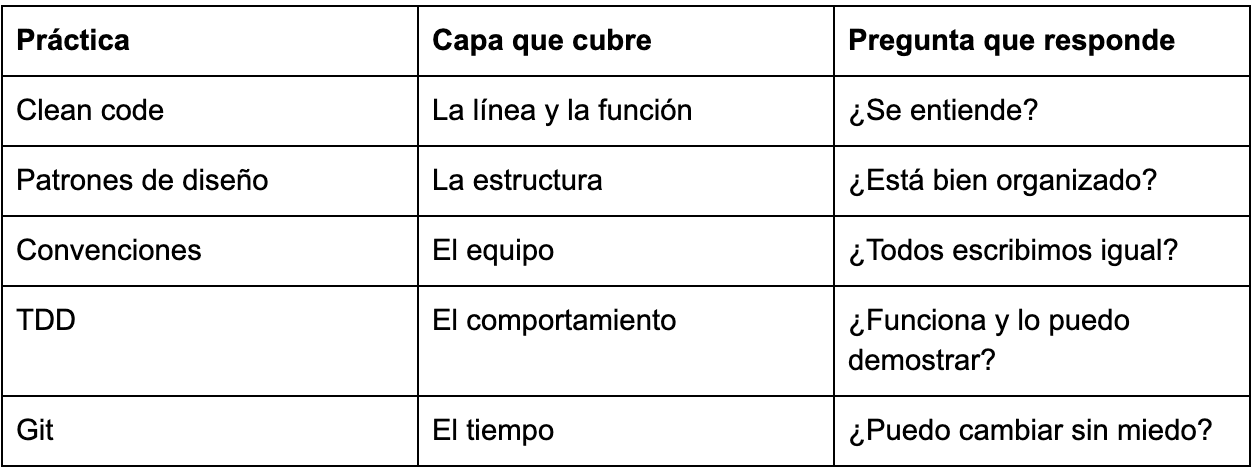
The cycle that reinforces itself
TDD gives you a safety net: if the tests pass, you didn't break anything. That net gives you permission to refactor without fear (Fowler, 2018). Refactoring leads you toward clean code. Patterns give you the vocabulary to know where to refactor. Conventions scale that judgment from the individual to the team. And Git makes every step reversible, while also telling the story of why each decision was made.
What happens if you remove one piece
Remove TDD and the fear of touching the code appears: refactoring freezes. Remove clean code and the tests protect a spaghetti: everything green, but nobody understands what. Remove conventions and each file looks like it belongs to a different project. Remove well-used Git and the system loses the memory of why it is the way it is.
The value is not in each practice. It is in the cycle.
Application in companies
For the business, this combo is not an aesthetic preference: it is software economics.
The real cost of a system is not in writing it, it is in maintaining it. Martin (2008) estimates that the time a developer spends reading code exceeds the time spent writing it by more than 10 to 1. Optimizing readability is optimizing the operational cost of the entire team, every day.
And there is quantitative evidence: the research behind Accelerate found that practices such as version control, test automation, and continuous integration predict software delivery performance, and that this performance predicts organizational outcomes such as profitability and market share (Forsgren et al., 2018).
Translated into concrete benefits:
- Faster onboarding: with conventions and clean code, a new developer contributes in days, not months.
- Fewer regressions: tests turn every change into a controlled risk instead of a gamble.
- Sustainable speed: the team with the combo seems slower the first week and is faster every month after that.
- Traceability: a well-maintained Git history answers "why was it done this way?" with evidence, not archaeology.
Best practices for adopting the combo
- Start with well-used Git. Atomic commits and messages that explain the why, not the what. It is the cheapest practice to adopt and the one that gives the most context to the future: to yourself six months from now and to the agents that read the repository.
- Pragmatic TDD, not religious. Start with business logic that has clear rules: there, every test is worth gold (Beck, 2002). The goal is not total coverage; it is the confidence to change.
- Clean code as a habit, not a crusade. The boy scout rule: leave the code a little better than you found it. Epic rewrites almost never happen; small, continuous refactors do.
- Patterns for naming, not for showing off. The pattern arrives when the problem appears, not before. Over-engineering is the typical code smell of someone who has just learned patterns.
- Automate conventions. Linters, formatters, and hooks take style discussions out of code review and leave the review for what matters: design.
Conclusion
None of this means you should not learn languages: learn the ones your context requires. The question is what asset you are buying with your time. Syntax is rented per project; judgment is yours forever.
Clean code, conventions, design patterns, TDD, and Git form the system that turns someone who writes code into someone who designs software that others—humans and agents—can understand, verify, and evolve. In an industry where code is generated faster and faster, that judgment is not what AI replaces: it is what AI makes more valuable.
Adopting these practices not only improves technical efficiency, but also allows companies to optimize their processes, reduce costs, and scale solutions safely and sustainably. At Kranio, we have specialized teams that have implemented this type of solution in real enterprise projects.
👨💻 If your company is looking to implement this type of solution, you can contact us at 👉 www.kranio.io
References
Beck, K. (2002). Test-driven development: By example. Addison-Wesley.
Forsgren, N., Humble, J., & Kim, G. (2018). Accelerate: The science of lean software and DevOps. IT Revolution Press.
Fowler, M. (2018). Refactoring: Improving the design of existing code (2nd ed.). Addison-Wesley.
Gamma, E., Helm, R., Johnson, R., & Vlissides, J. (1994). Design patterns: Elements of reusable object-oriented software. Addison-Wesley.
Martin, R. C. (2008). Clean code: A handbook of agile software craftsmanship. Prentice Hall.
Previous Posts

Patterns and Anti-Patterns in Unit Testing with JUnit and Mockito
Discover the main patterns and antipatterns in unit testing with JUnit and Mockito to create cleaner, more maintainable, and reliable tests.
ETL vs ELT: Differences, Use Cases, and Best Tools
ETL or ELT? Learn their differences, advantages, top modern tools, and practical use cases explained clearly and without complications.