
ETL vs ELT: Differences, Use Cases, and Best Tools

Cloud Data Processing Infrastructure and Evolution
1. Introduction: Why Is the ETL vs. ELT Debate More Alive Than Ever?
In any data project, the main goal is simple: take information from different places (transactional databases, APIs, mobile applications, or third-party systems) and get it ready for the business to make smart decisions.
However, the path data travels before reaching a report or a machine learning model has changed drastically in recent years. For decades, the undisputed standard was the ETL model (Extract, Transform, Load). But with the arrival of elastic storage and modern cloud data warehouses (Cloud Data Warehouses), the ELT paradigm (Extract, Load, Transform) became a powerful and accessible alternative.
Understanding the ETL vs. ELT debate is not merely a semantic question or a matter of software trends. The decision directly impacts how much money you spend on servers each month, how quickly your analysts get answers, and how easy it is to comply with security or audit standards.
In this guide, we explain what each architecture means, how they differ, how they are applied in high-rigor scenarios (with examples from the banking and financial sector), and which are the best tools to implement each one successfully.
2. What Is ETL and What Is ELT? Explained Simply
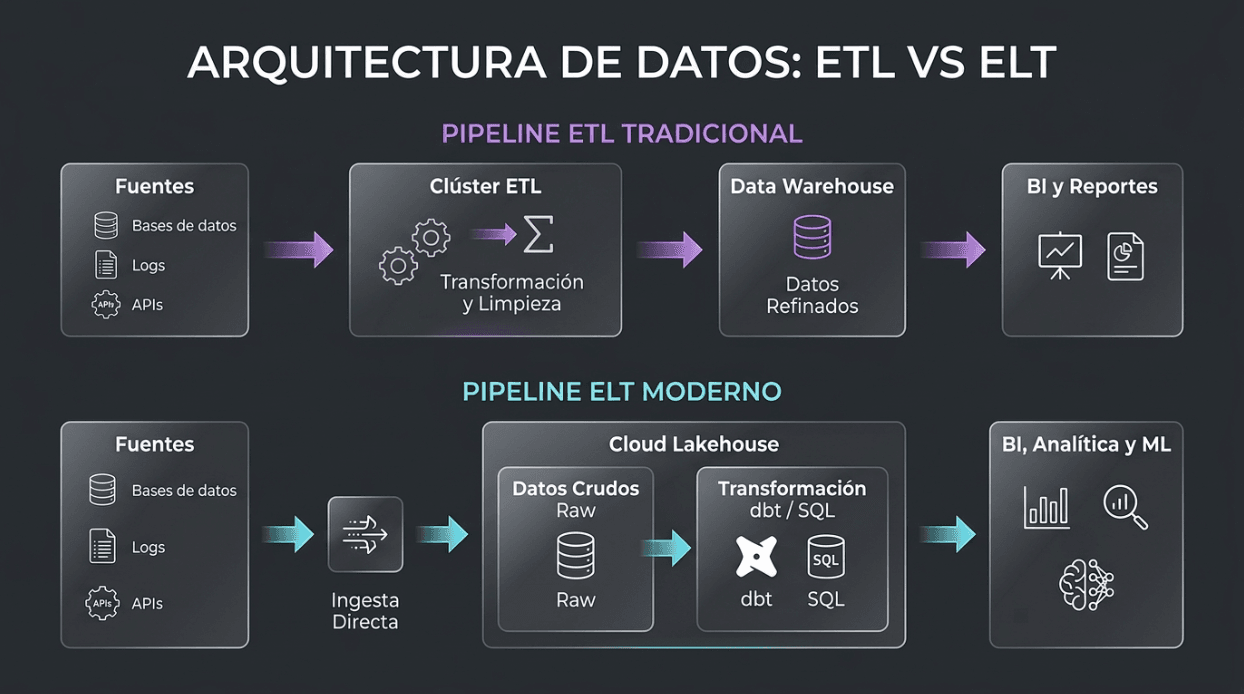
Comparative architecture: Intermediate processing (ETL) vs. In-Warehouse processing (ELT)
To understand both concepts without getting lost in unnecessary technicalities, it helps to think of a culinary analogy: preparing ingredients in a restaurant.
2.1. ETL: The Traditional Kitchen
In ETL, data is extracted from the sources, sent to a separate processing server where it is cleaned, sorted, and transformed, and only when it is completely ready and polished is it stored in the final destination.
It is like peeling, chopping, and cooking the vegetables in the kitchen before bringing the dish to the diner's table. The customer only sees the final result.
- Advantage: Only refined and clean data enters the final destination.
- Disadvantage: If an analyst later needs a raw data point that you discarded during the previous preparation, you have to go back and find it in the original source.
2.2. ELT: The Modern Buffet with Live Preparation
In ELT, you first extract the data and load it as it comes into a central warehouse with large storage and compute capacity. Once the raw data is stored, you run the transformations directly inside the destination engine when you need them.
It is like taking all the fresh ingredients directly to a high-tech self-service pantry and cooking them on the spot according to each person's specific order.
- Advantage: You keep the entire original history without modifying it. If the business rules change, you only change the query or model, without re-extracting the data.
- Disadvantage: It requires strict access controls so that users do not consume messy data or confidential information that has not yet been masked.
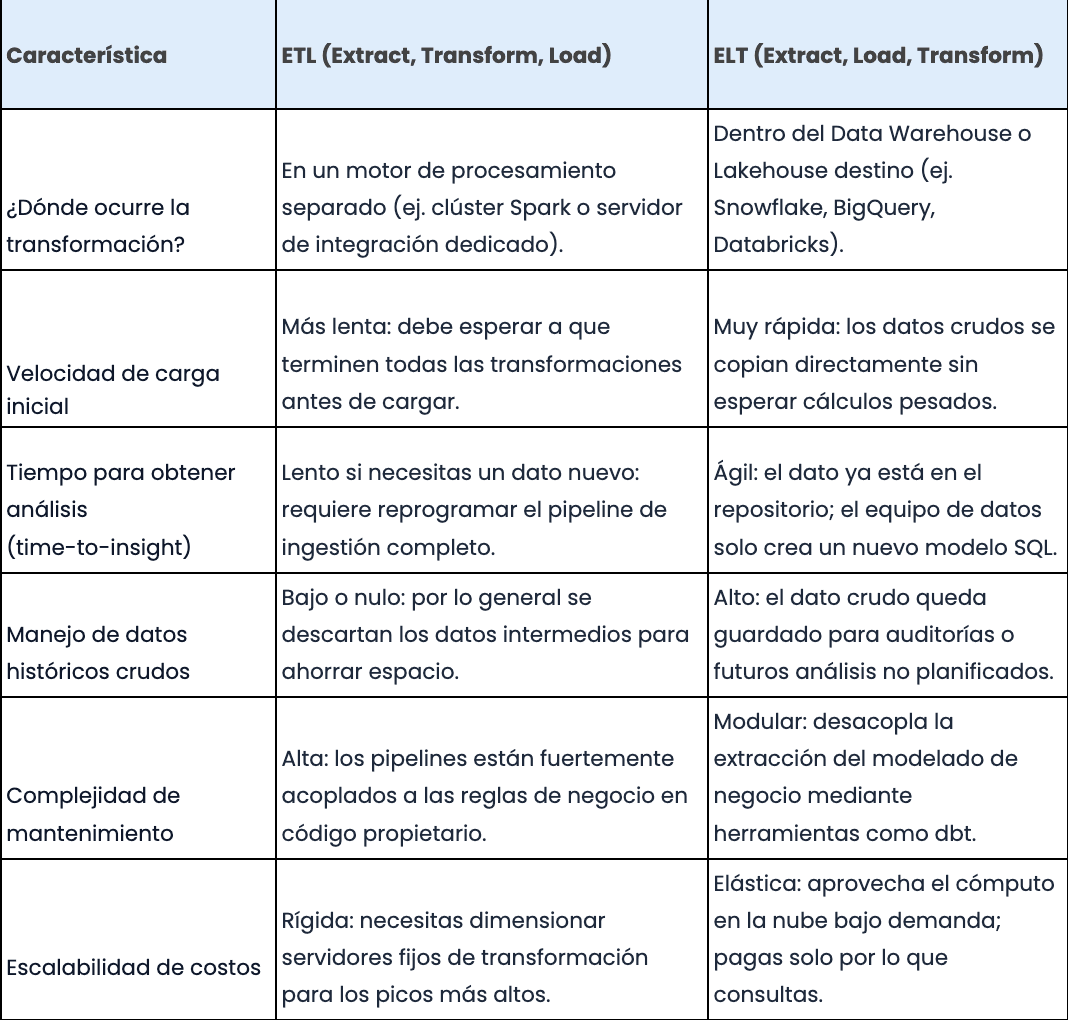
3. Key Differences: ETL vs. ELT Head-to-Head
At first glance, it seems like just a change in the order of two letters, but the underlying architecture is completely different.
4. Real Use Cases: When to Choose Each One?
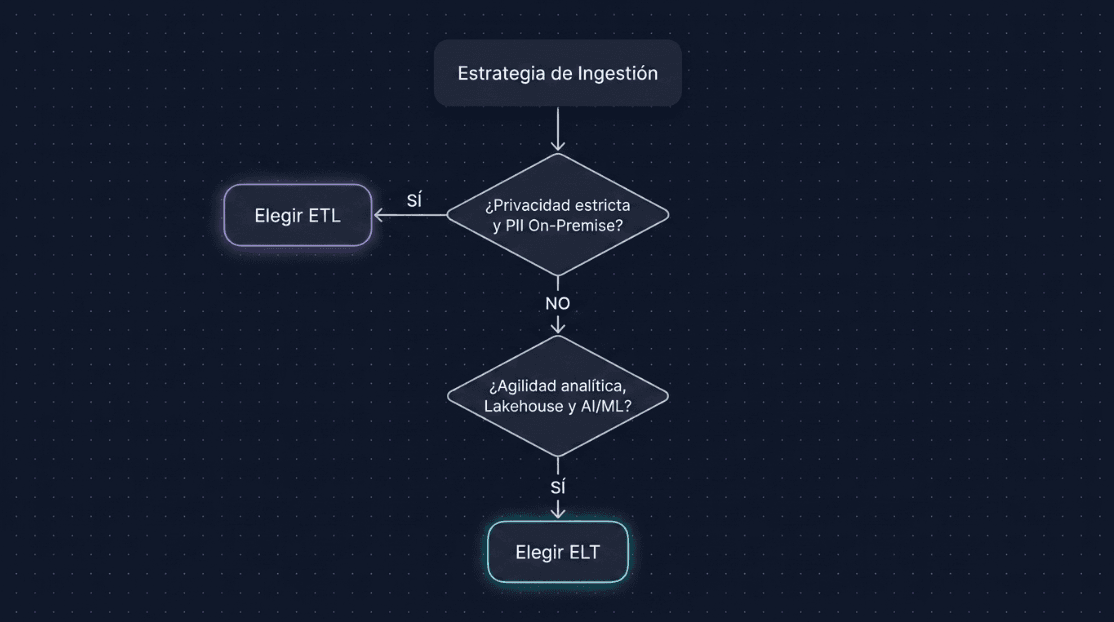
Decision tree: Technical criteria for choosing between ETL and ELT
There is no single solution. The right choice depends on your sources, your regulatory constraints, and your engineering team's skills.
4.1. When ETL Is the Better Fit for You
The traditional model remains the undisputed king in situations where strict security and isolated perimeters do not allow flexibility.
- Protection of sensitive data and privacy (PII): In sectors such as banking and insurance, certain regulations (such as PCI-DSS or personal data protection laws) require that credit card numbers, identity documents, or passwords never leave the company's secure perimeter without first being anonymized or tokenized. With ETL, data is masked in memory before being transferred to any secondary storage.
- Legacy systems with complex formats: If you extract data from an old mainframe (such as a banking AS/400) with binary files or proprietary formats (EBCDIC/COBOL copybooks), transforming and structuring it before loading it into a relational repository saves compatibility issues.
- Consolidation of ERPs, inventories, and invoicing (Zero tolerance for inconsistencies): In sectors such as retail, e-commerce, manufacturing, and logistics, month-end closings and omnichannel inventory synchronization do not forgive discrepancies. If corrupt or outdated data is loaded from the ERP (SAP, Oracle, NetSuite), stock levels and tax reports are distorted. With ETL, data is validated, cleaned, and mathematically reconciled before touching the analytical warehouse, ensuring the business always makes decisions based on audited and accurate numbers.
4.2. When you should use ELT
The ELT model is preferred for agile analytics, digital products, and modern cloud ecosystems.
- Fraud detection and credit scoring: Imagine a bank analyzing millions of debit and credit card transactions per second. Machine Learning models need not only the purchase amount, but also contextual metadata: IP, device, browser, latency, and geographic location. With ELT, all that raw information is stored immediately in the Lakehouse so anomaly detection algorithms can process it without prior filters.
- 360° customer view and omnichannel: A user checks their balance in the mobile app, makes a web transfer, calls the call center, and visits an ATM. Integrating all these disparate sources is much easier if they are first deposited raw and then unified through structured SQL models.
- Agile analytics for Marketing, Product, and Sales (Continuous change of metrics): In companies with digital channels, SaaS, or e-commerce, the formulas for measuring customer lifetime value (LTV), customer acquisition cost (CAC), or advertising attribution change constantly. With a traditional schema, each adjustment requires opening a ticket to data engineering and waiting weeks. With ELT, by having all the raw history in the Lakehouse, the analytics team simply updates a SQL model in dbt to recalculate months of history in minutes, without touching operational systems or slowing down the commercial team.
5. The modern data stack: The best tools
Nowadays you don't need to build pipelines from scratch. There is a robust ecosystem of leading tools that solve each stage of the flow:
5.1. For Ingestion and Replication (E and L)
- Fivetran and Airbyte: They automate the extraction from hundreds of connectors (SaaS, CRMs, transactional databases) and load them transparently into your data warehouse.
- Debezium \+ Apache Kafka: The engineering-grade option for capturing real-time changes (Change Data Capture \- CDC) directly from transactional logs (Postgres, Oracle, MySQL) without overloading production databases.
5.2. For Transformation and Modeling (T)
- dbt (data build tool): The tool that revolutionized the ELT ecosystem. It allows anyone who knows SQL to build reusable transformation models, document dependencies, manage lineage (data lineage), and run automated unit tests with version control in Git.
- Apache Spark / Databricks: The leading platform for massive-scale transformations, live stream processing, and feature preparation for artificial intelligence.
5.3. For Orchestration and Monitoring
- Apache Airflow and Dagster: The standards for scheduling, coordinating, and alerting on dependencies between data ingestion, dbt model execution, and BI dashboard refreshes.
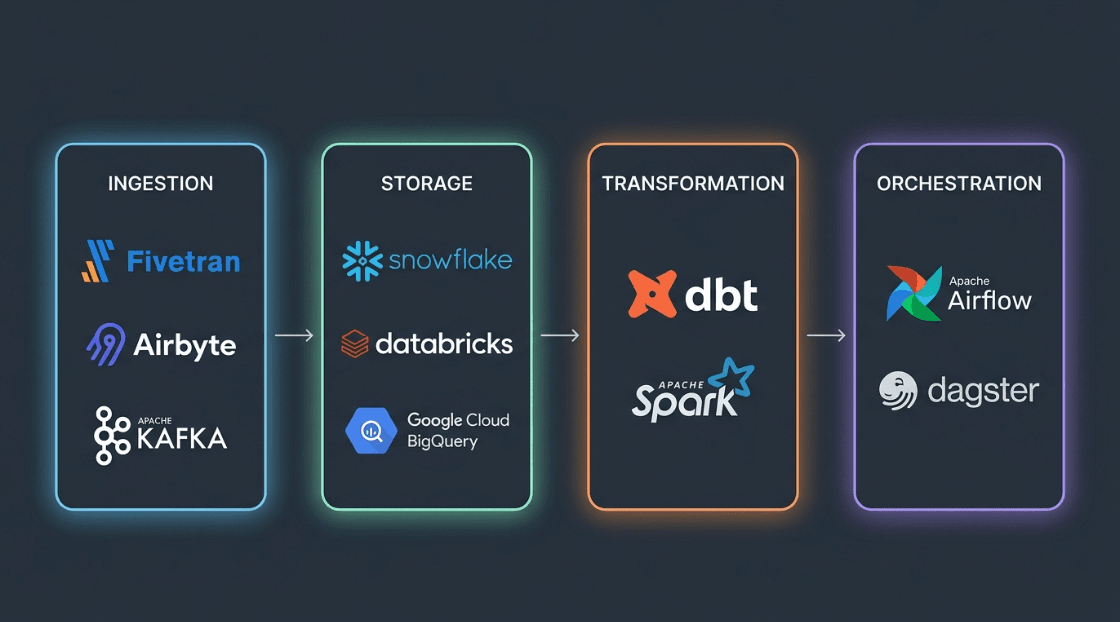
Leading ecosystem and tools of the Modern Data Stack
6. Business impact: How does this decision affect your business?
Choosing correctly between ETL and ELT doesn't just make the engineering team happy; it directly impacts the company's bottom line:
- Accelerated Time-to-Market: In an ELT scheme with dbt, responding to a new business question takes days or even hours, instead of the weeks it used to take to coordinate changes in legacy ETL pipelines.
- Cloud cost optimization (FinOps): Cloud warehouses allow compute to be suspended when no transformation is running. There's no longer a need to pay for dedicated servers running 24/7 just to wait for midnight processing.
- Governance and reliable lineage: Knowing exactly which table and column the numbers seen by the management committee or the board of directors come from prevents costly errors and speeds up external audits.
7. Conclusion: The hybrid approach as a best practice
The comparison between ETL vs ELT is not a fight to the death where one paradigm must eliminate the other. In mature, high-scale architectures, the best practice is usually a hybrid model:
- Use a lightweight ETL at the start: Apply basic schema validations and mask sensitive data (PII) at the edge before sending the information to the cloud.
- Use ELT for the rest of the journey: Store data in ordered layers (Bronze, Silver, Gold) and let the power of modern engines like Snowflake or Databricks, together with dbt, handle modeling your business's analytical logic.
Recent research in data architecture (Kashyap & Ramamurthy, 2025\) formalizes this approach as hybrid ETLT patterns (Extract-Transform-Load-Transform), where governance and privacy tasks are resolved before loading, while analytical business rules are transferred to the elastic engine.
References
- Armbrust, M., Ghodsi, A., Xin, R., & Zaharia, M. (2021). Lakehouse: A new generation of open platforms that unify data warehousing and advanced analytics. Proceedings of the 11th Conference on Innovative Data Systems Research (CIDR 2021\). https://www.cidrdb.org/cidr2021/papers/cidr2021\_paper17.pdf
- Google Cloud Architecture Center. (2024). Data lifecycle and modern data pipelines: Building scalable ETL and ELT architectures with BigQuery. Google Cloud Technical Documentation. https://cloud.google.com/architecture/data-lifecycle-cloud-dataflow
- Kashyap, S., & Ramamurthy, B. (2025). Formalizing ETLT and ELTL design patterns and proposing enhanced variants \[Preprint\]. arXiv. https://arxiv.org/abs/2511.03393
- Vassiliadis, P. (2009). A survey of Extract-Transform-Load technology. International Journal of Data Warehousing and Mining (IJDWM), 5(3), 1–27. https://doi.org/10.4018/jdwm.2009070101
- dbt Labs. (2025). The state of analytics engineering: Trends in ELT, in-warehouse modeling, and data governance. dbt Labs Research. https://www.getdbt.com/state-of-analytics-engineering
Implementing ETL and ELT architectures not only improves the technical efficiency of the data flow, but also enables companies to optimize their processes, reduce costs, and scale analytical solutions securely and sustainably. At Kranio we have specialized teams that have implemented this type of solution in real enterprise projects within demanding sectors such as banking, finance, and retail.
👨💻 If your company is looking to modernize its data pipelines, optimize cloud costs, or improve the governance of its information, you can contact us at 👉 www.kranio.io
Previous Posts
Fine-tuning for fraud detection: when it makes sense
Technical guide to fine-tuning for fraud detection: when it outperforms training from scratch, real-world impact, and MLOps architecture on AWS.
Clean Code, TDD, and Git: why they are worth more than learning 5 languages
Discover why mastering Clean Code, TDD, Git, patterns, and conventions can add more value to your career than accumulating new programming languages.