
Data Lake or Data Warehouse? Which to Choose and the Differences

Evolution of analytical platforms: Flexibility in the Data Lake vs Structure in the Data Warehouse
1. Introduction: The storage and processing dilemma in the era of big data
As organizations scale their digital operations, the volume, velocity, and variety of their information grow exponentially. The classic premise that "data is the new oil" today faces a real operational challenge: without the right infrastructure, unrefined data becomes a costly liability instead of a strategic asset.
When designing or modernizing an enterprise analytical platform, the recurring question from engineering and technology leadership teams is: Data Lake or Data Warehouse? Choosing between one or the other is not a simple debate about software brands or cloud trends. This decision defines the agility with which your company responds to market demands, the ease of training Artificial Intelligence and Machine Learning models, and the direct impact on the monthly cloud services bill.
Historically, both repositories were born to solve complementary problems but with opposing philosophies. While the Data Warehouse was designed for mathematical precision and structured business reports, the Data Lake emerged to democratize massive, cost-effective storage of data in its raw state.
In this technical guide, we break down the fundamental architecture differences, analyze their most representative enterprise use cases, and explore how the evolution toward the Data Lakehouse is redefining decision-making in leading organizations.
2. What is a Data Lake and what is a Data Warehouse? Explained simply
To understand the conceptual difference without getting lost in technical language, it is useful to resort to an analogy from the physical world: the difference between a large natural water reservoir and a bottling plant with a premium supermarket.
2.1. Data Warehouse: The structured supermarket
A Data Warehouse is a centralized repository optimized for fast analysis of highly structured historical data. Data entering a warehouse must first go through strict cleaning, typing, and dimensional modeling processes (such as star or snowflake schemas).
It is comparable to a supermarket where each product is perfectly classified, labeled with its barcode, weighed, and placed on a designated shelf.
- Schema-on-Write philosophy: The table schema must be defined before a single record can be inserted.
- Typical consumers: Business analysts, finance teams, executives, and Business Intelligence (BI) dashboards.
- Strength: Ultra-fast SQL queries, complex aggregations, and absolute mathematical consistency (traditional ACID transactions).
2.2. Data Lake: The natural reservoir
A Data Lake is a massive repository capable of storing colossal amounts of data in its original or raw format, without the need to structure it in advance. It can simultaneously host structured data (relational tables), semi-structured data (JSON files, server logs, Parquet, XML), and unstructured data (PDF documents, audio, images, and video).
It is like a large natural basin or reservoir that receives water from multiple rivers and tributaries. The water is stored as it arrives and is only filtered or purified when someone extracts it for a specific purpose.
- Schema-on-Read philosophy: Data is stored without a mandatory schema; the structure is applied through code at the time of reading or querying it.
- Typical consumers: Data scientists, Machine Learning engineers, and researchers.
- Strength: Extremely low storage cost, full ingestion flexibility, and the ability to train advanced predictive models on complete historical data.
3. Comparison Matrix: Data Lake vs Data Warehouse head-to-head
Below, we contrast the key technical and operational dimensions that determine the viability of each technology in a corporate environment:
| Technical Dimension | Data Warehouse | Data Lake |
|---|---|---|
| Supported Data Types | Exclusively structured and relational (tables, typed columns). | Structured, semi-structured (JSON, logs), and unstructured (images, audio, text). |
| Schema Definition | Schema-on-Write (rigid schema before loading). | Schema-on-Read (flexible schema applied at read time). |
| Storage Costs | High: High-performance optimized storage coupled or integrated with compute. | Very low: Tiered storage of low-cost cloud object storage (AWS S3, Azure Blob, GCS). |
| Query Speed | Very fast for analytical SQL queries, aggregations, and business filters. | Variable: Fast for massively parallel reads (Spark), but slow for direct ad-hoc queries without indexing. |
| Primary User Profile | BI analysts, business users, directors, and financial controllers. | Data scientists, ML engineers, big data developers. |
| Governance and Control | Very high and centralized: column/row-level permissions, strict catalogs, and native auditing. | Complex: if not actively governed, it risks degrading into a Data Swamp. |
| Primary Use Cases | Financial reporting, operational KPIs, dashboards, and descriptive analytics. | Machine Learning, exploratory analytics, IoT stream analytics, and massive telemetry ingestion. |
4. Real-world use cases: When should each solution be implemented?
There is no universal answer to the dilemma of choosing a Data Lake or Data Warehouse. Mature organizations determine the ideal tool based on the business use case and latency and governance requirements.
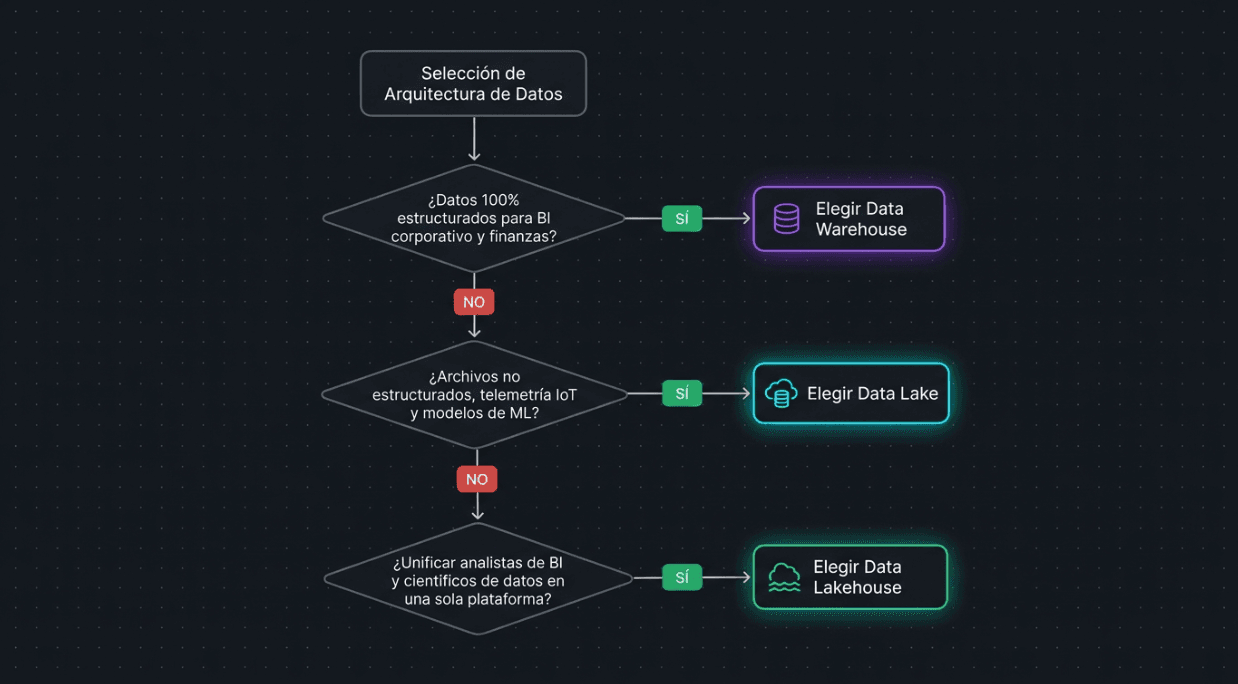
Decision tree: Technical criteria for choosing between Data Warehouse, Data Lake, and Lakehouse
4.1. Scenarios where the Data Warehouse is the right choice
- Accounting closes, billing, and regulatory reporting: In regulated sectors such as banking, insurance, and financial services, income statements and balance sheets do not allow for approximations. A Data Warehouse ensures that the figures shown in executive dashboards match exactly with the accounting general ledger and core ERP systems.
- Executive dashboards and corporate BI with low latency: When dozens or hundreds of directors and product managers simultaneously query dashboards in Power BI, Tableau, or Looker, the indexed and partitioned query engine of a Data Warehouse responds in milliseconds without degrading performance.
- Standardized operational business metrics: Calculation of recurring revenue (ARR/MRR), customer acquisition cost (CAC), and inventory turnover where the entire company must share a "Single Source of Truth."
4.2. Scenarios where the Data Lake is the superior choice
- Artificial Intelligence and Machine Learning models: To train fraud detection algorithms, e-commerce recommendation models, or computer vision, data scientists need raw data without prior aggregations. The Data Lake preserves the complete metadata of network data, clickstreams, and original timestamps.
- Massive ingestion of IoT, telemetry, and sensors: In logistics, transportation, or manufacturing companies that monitor fleets or industrial machinery through sensors emitting millions of signals per minute, loading that data directly into a Data Warehouse would be unfeasible in terms of cost. A Data Lake absorbs massive volumes in seconds at a negligible storage cost.
- Storage of unstructured files for future analysis: Archiving digitized contracts in PDF, call center recordings, and technical support transcripts for subsequent natural language processing (NLP) and sentiment analysis.
5. Modern convergence: What is a Data Lakehouse?
For years, companies had to maintain two isolated platforms: a Data Lake for data science and a Data Warehouse for the business, building costly synchronization pipelines between them that generated duplication, inconsistencies, and cost overruns.
To eliminate this friction, the industry evolved toward the Data Lakehouse paradigm, a hybrid architecture that implements the best capabilities of a Data Warehouse on top of the economical storage of a Data Lake:
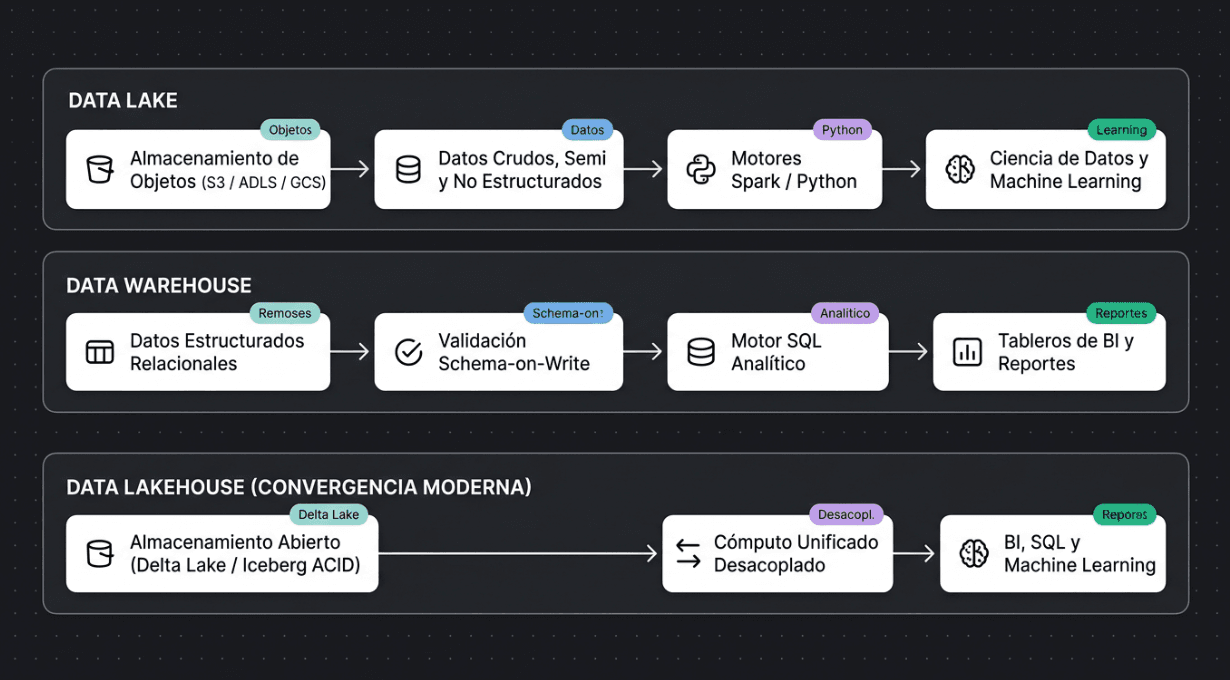
Comparative architecture: Data Lake, Data Warehouse, and the modern convergence in Data Lakehouse
Pillars of the Data Lakehouse
- Open Table Formats: Through technologies such as Apache Iceberg, Delta Lake, and Apache Hudi, the Lakehouse adds a metadata layer on top of Parquet files that enables ACID transactions (atomicity, consistency, isolation, and durability).
- Time Travel and Versioning Support: It allows querying the exact state of the data at a previous historical point, facilitating forensic audits and accurate reproductions of Machine Learning experiments.
- Full decoupling between compute and storage: Data resides in secure cloud storage buckets, and multiple independent compute engines (SQL for analysts, Python/Spark for scientists) read directly from the same repository without duplicating data.
6. Tool Ecosystem and FinOps Governance
The success of a modern data architecture depends not only on the chosen technology but also on financial discipline (FinOps) and governance policies applied from day one:
6.1. Market-leading tools
- For Data Warehouses: Snowflake, Google BigQuery, and Amazon Redshift. They stand out for their self-managed elastic compute capacity and native support for advanced SQL.
- For Data Lakes: Amazon S3, Azure Data Lake Storage (ADLS Gen2), and Google Cloud Storage (GCS), complemented by query engines such as Apache Spark and Presto/Trino.
- For Data Lakehouses: Databricks (pioneer of the concept) and modern warehouses with support for open formats such as Snowflake with Iceberg Tables.
6.2. Avoiding the "Data Swamp"
The biggest risk of a Data Lake is the lack of governance. When teams accumulate petabytes of data without documentation, lineage, or catalogs, the lake becomes an inaccessible swamp. To mitigate this, the following is required:
- Automated data catalog: Use of solutions such as Unity Catalog, AWS Glue, or Apache Atlas to classify datasets and define data owners.
- Storage lifecycle policies: Automatically move historical data with infrequent access to cold storage tiers (Glacier / Archive) to reduce costs by up to 70%.
- Quality control at ingestion: Automated schema integrity validations to prevent corrupted data from reaching analytical models.
7. Conclusion: The criteria for making your decision
When answering the question of Data Lake or Data Warehouse, the technical conclusion of modern data engineering is not to select one and discard the other, but to evaluate the maturity of your use cases:
- If your immediate priority is business analysis, financial reports, and standardized dashboards: Start with a modern Data Warehouse. Implementation speed and data consistency will justify the investment in the short term.
- If you handle large volumes of semi-structured data, advanced AI projects, or continuous telemetry: Build a solid Data Lake on cloud object storage.
- If you are looking for a scalable long-term platform that unifies data analysts and data scientists: Adopt a Data Lakehouse strategy. This architecture eliminates data duplication, optimizes operating costs, and offers maximum technological flexibility for your company's future.
References
- Amazon Web Services. (2024). What is a Data Lake? Architecture, benefits, and data warehouse integration. AWS Cloud Data Architecture Guides. https\://aws.amazon.com/what-is/data-lake/
- Armbrust, M., Ghodsi, A., Xin, R., & Zaharia, M. (2021). Lakehouse: A new generation of open platforms that unify data warehousing and advanced analytics. Proceedings of the 11th Conference on Innovative Data Systems Research (CIDR 2021\). https\://www\.cidrdb.org/cidr2021/papers/cidr2021\_paper17.pdf
- Databricks. (2020). What is a Data Lakehouse? Architecture, governance, and unified analytics. Databricks Technical Blog. https\://www\.databricks.com/blog/what-is-data-lakehouse
- Google Cloud. (2024). What is a Data Lake? Key concepts, storage, and analytics. Google Cloud Architecture Documentation. https\://cloud.google.com/learn/what-is-a-data-lake
- Snowflake. (2024). Snowflake Data Lakes: Governed Data Lakehouse for AI and Analytics. Snowflake Product Guides. https\://www\.snowflake.com/en/product/data-engineering/data-lake/
The strategic implementation of Data Lake, Data Warehouse, and Lakehouse architectures not only modernizes an organization's technical ecosystem but also substantially reduces infrastructure costs, accelerates decision-making, and democratizes the use of advanced analytics. At Kranio, we have specialized data architecture and engineering teams that have implemented high-performance analytical solutions in highly demanding business sectors such as banking, insurance, retail, and telecommunications.
👨💻 If your company is looking to design a scalable data architecture, migrate to the cloud, or evaluate the feasibility of a Data Lakehouse, you can contact us at 👉 www\.kranio.io
Previous Posts

Archify: How to review architecture diagrams with AI
Discover how to review AI-generated architecture diagrams, validate their relationships with Archify, and detect assumptions before using them.

Patterns and Anti-Patterns in Unit Testing with JUnit and Mockito
Discover the main patterns and antipatterns in unit testing with JUnit and Mockito to create cleaner, more maintainable, and reliable tests.