
RabbitMQ (the king of queues) or Apache Kafka (the event streaming giant)?

In the world of software development and distributed architectures, choosing the right tool for handling messaging between systems can make the difference between an efficient solution and one full of problems. Two of the most popular options are: queue-based messaging (RabbitMQ) and Apache Kafka, a real-time data streaming platform. Although both aim to facilitate message exchange, they are designed to solve different types of problems and have very distinct characteristics.
In this article, we will explore the key differences between these technologies, their pros and cons. And since we are in 2026, we add an important twist: in their latest versions, both platforms have moved closer together, and each has incorporated the core idea of the other. If you are a software developer or architect, this guide will help you make an informed decision when implementing messaging in your applications.
Before reaching for a full message broker, evaluate the actual scale of the integration: many internal workflows are better served by lightweight glue code such as Google Apps Script, which connects Google Workspace services with a few lines of JavaScript.
What is RabbitMQ?
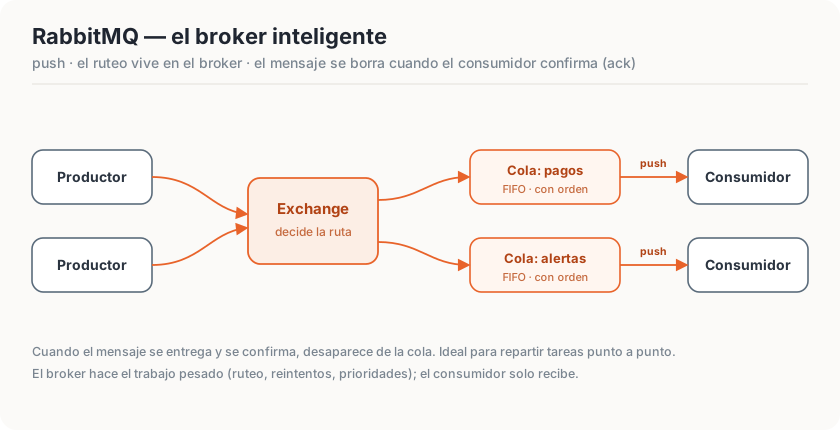
RabbitMQ is one of the most popular and traditional message brokers in the software world. It implements protocols like AMQP and operates under the Producer/Consumer model: one system produces messages, RabbitMQ places them in a queue, and another system consumes them.
A perfect tool for scenarios where messages need to be processed in order and delivered with guarantees. Due to its simplicity and ease of use, this type of tool is ideal for traditional enterprise applications or basic integration systems.
Features
- Push model: Messages are actively sent to consumers.
- Persistence: Messages can be stored until they are confirmed as delivered.
- Point-to-point approach: Typically, a message is consumed by a single consumer.
The key detail lies in the ack: the message is only deleted from the queue when the consumer confirms it has been processed. If the consumer crashes before that, RabbitMQ redelivers it.
// Producer: publishes to the "payments" queue
channel.queueDeclare("payments", true, false, false, null); // durable=true
channel.basicPublish("", "payments", null, message.getBytes());

// Consumer: processes and confirms with manual ack
channel.basicQos(1); // one message at a time
channel.basicConsume("payments", false, (tag, delivery) -> {
    process(new String(delivery.getBody()));
    // only now the message is deleted from the queue:
    channel.basicAck(delivery.getEnvelope().getDeliveryTag(), false);
}, tag -> {});
What is Apache Kafka?
Apache Kafka, on the other hand, is a data streaming platform designed to handle large volumes of messages in real time. It is often positioned as a solution for log analysis, event processing, and distributed systems requiring high availability.
Kafka is known for its performance and ability to manage real-time data streams, making it ideal for modern applications and large-scale systems.
Features
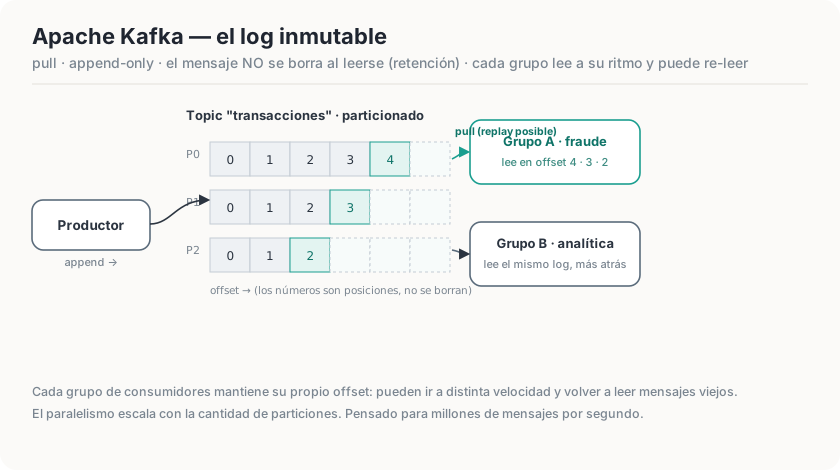
- Pull model: Consumers read messages from the log when they need them.
- Long-term persistence: Messages are stored for a defined period, even after being consumed.
- High scalability: Designed to handle millions of messages per second with ease.
- Publish/subscribe model: Messages can be read by multiple consumers simultaneously.
Unlike a queue, Kafka is an append-only log: reading a message does not delete it; it remains at its position (offset) for the retention period. This is why replay (re-reading old events) is possible.
// Producer: writes an event to the "transactions" topic
// The key (account id) determines which partition the message goes to
producer.send(new ProducerRecord<>("transactions", "account-4821", "{\"amount\":15000}"));
// Consumer: reads from the log within a group (pull model)
consumer.subscribe(List.of("transactions"));
while (true) {
var records = consumer.poll(Duration.ofMillis(500)); // pull
for (var r : records)
System.out.printf("offset=%d value=%s%n", r.offset(), r.value());
}
* "Note: By default, this consumer automatically commits (auto-commit) the offsets it reads in the background."
---
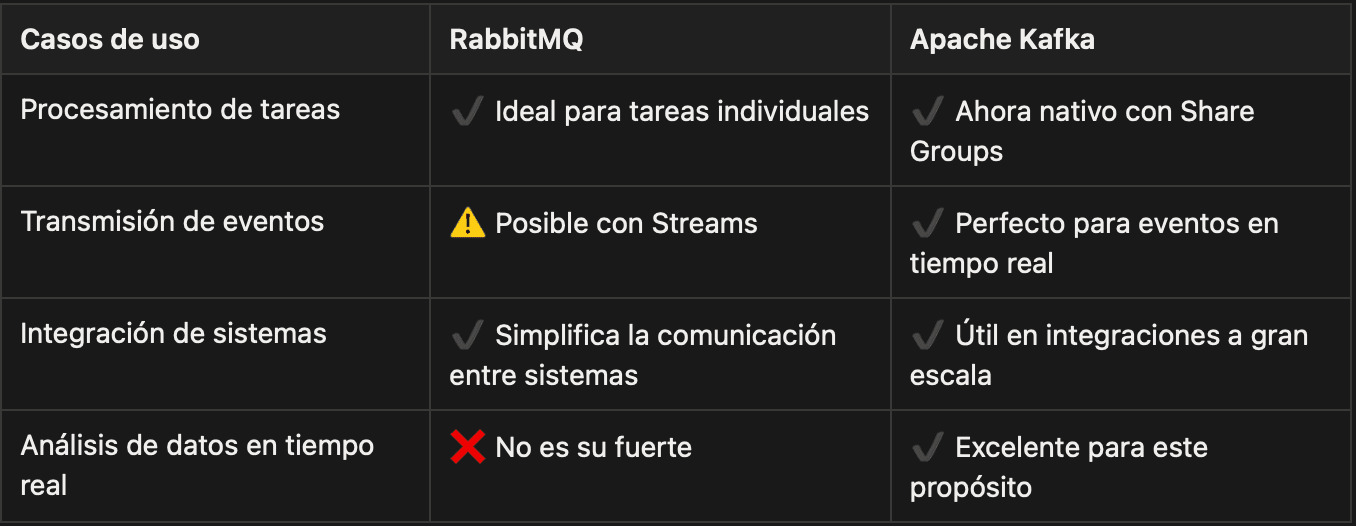
## Comparison Table
---
## The 2026 News: Borders Are Blurring
RabbitMQ 4.x was drastically strengthened and consolidated its bet on streaming. It added Khepri, a Raft-based metadata store that replaces Mnesia (providing greater consistency during network partitions and better recovery), native support for AMQP 1.0, and quorum queues with native priorities and retry limits. Additionally, to compete in the streaming arena, it boosts its **Streams**: an append-only log with retention and replay, conceptually identical to Kafka's model.
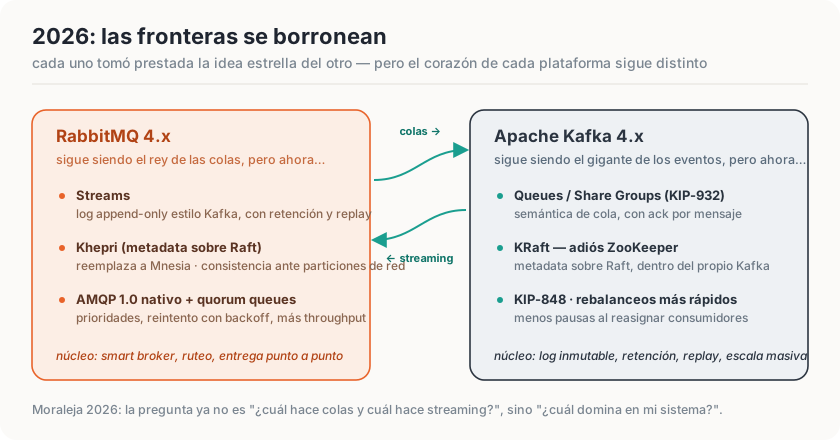
**Kafka 4.x fully entered the realm of traditional queues**. With the release of the 4.0 line, Kafka **completely eliminated ZooKeeper**: cluster metadata now lives within its own ecosystem via **KRaft** (its own Raft-based protocol), removing a critical operational piece. But the change that most shakes the board is **KIP-932 (Queues for Kafka / Share Groups)**: a new type of consumer group with queue semantics, per-message acknowledgment (*ack*), and multiple consumers reading in parallel from the same partition. In simple terms: Kafka can now distribute tasks exactly like a traditional messaging broker.
The fundamental question is: the question is no longer *"which one does queues and which one does streaming?"*, but rather **what is the dominant use case of my system and for which was each one originally designed?**
## Which One Should You Choose?
The choice between using RabbitMQ or Apache Kafka will depend entirely on what you need to solve in your project.
- **Choose RabbitMQ** if your application needs to send information from one point to another, distribute tasks, and work with a moderate volume of data, prioritizing order and reliability.
- **Choose Apache Kafka** if your application needs to handle large volumes of information, process data in real-time, or analyze event and log streams.
Rule of thumb: if your primary need is *"let someone do this task and delete it"*, think RabbitMQ. If it's *"let this event be recorded and readable by anyone, anytime"*, think Kafka.
The new features (Share Groups, Streams) serve to avoid adding a second platform for a minor case, but they don't change what each was designed for.
## Conclusion
Understanding the differences between RabbitMQ and Apache Kafka is essential for making informed decisions when designing systems that use messaging. While RabbitMQ offers simplicity and reliability in point-to-point scenarios, Kafka excels in environments requiring scalability and real-time processing.
What's new in 2026 is that the choice is no longer so binary: both platforms have come close enough to cover each other's use cases. Still, both technologies have their place in the software development world, and choosing one over the other will depend on the specific use case and technical requirements of your project. Carefully analyze the features, advantages, and disadvantages of each solution before implementing it.
Ultimately, the right tool is the one that allows you to build a robust, efficient, and scalable system.
**What solution are you considering for your next project? Have you already tried Kafka's Share Groups or RabbitMQ's Streams? Leave us your comments and share your experience!**Previous Posts
Patterns and Anti-Patterns in Unit Testing with JUnit and Mockito
Discover the main patterns and antipatterns in unit testing with JUnit and Mockito to create cleaner, more maintainable, and reliable tests.
ETL vs ELT: Differences, Use Cases, and Best Tools
ETL or ELT? Learn their differences, advantages, top modern tools, and practical use cases explained clearly and without complications.